


Perica™ MA
Proven standard. Release from pH 5.5.

The enteric coating is based on a 1:1 copolymer of methacrylic acid and ethyl acrylate. It protects the core in the stomach and releases the active ingredient only in the duodenum.
Perica™ MA is a solution for pharmaceutical manufacturers who require a consistent release threshold and a repeatable process.

How does it work?
The threshold that regulates the release
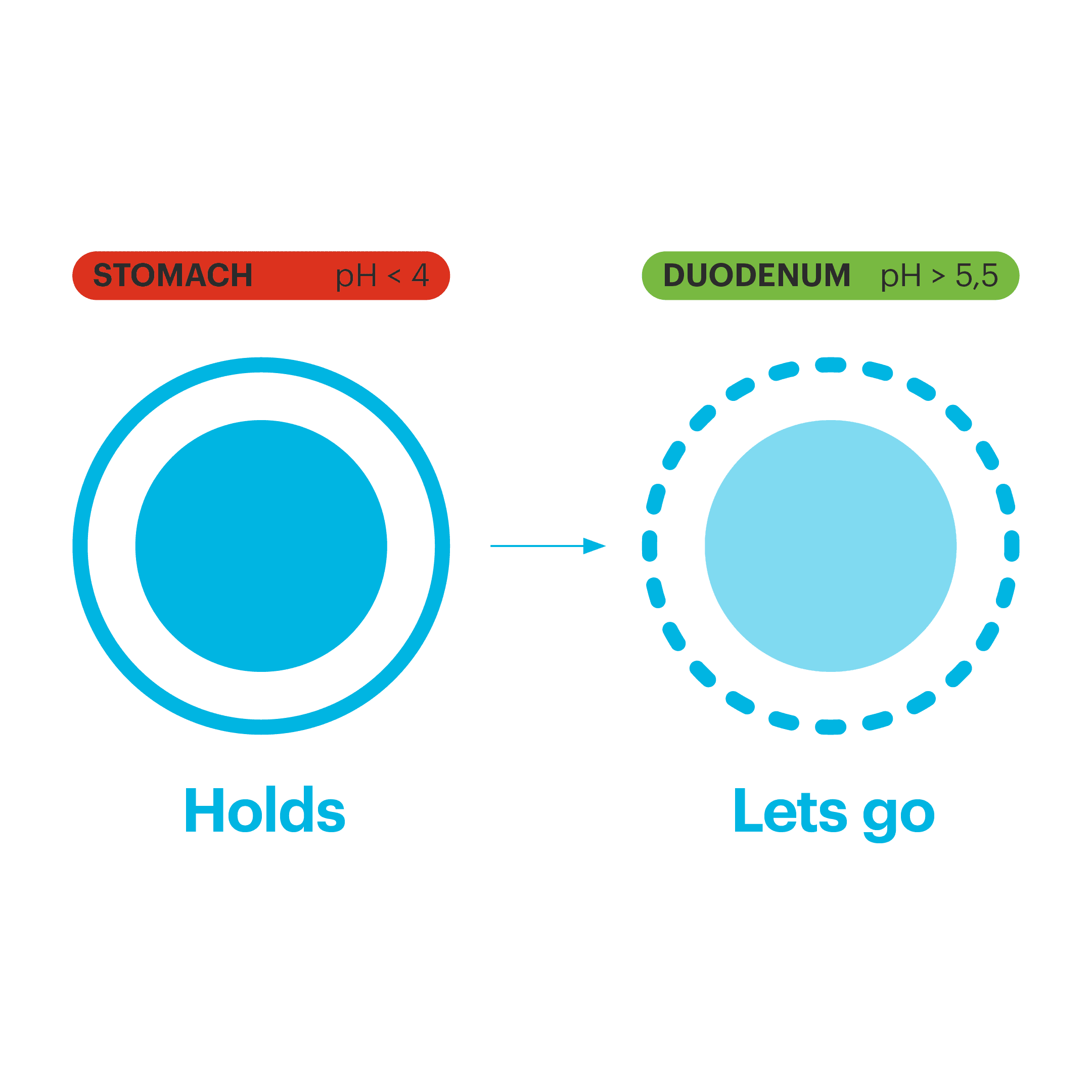
The copolymer contains carboxyl groups that remain insoluble in the acidic environment of the stomach, creating a tight barrier. Above pH 5.5, they ionize, the coating dissolves, and the contents are released in the duodenum.
The threshold is not set by the formulation—it results directly from the polymer's structure, and therefore is repeatable from batch to batch.
Features
Why Perica™ MA?

Release from pH 5.5. The active ingredient reaches the duodenum and not beyond. The threshold is determined by the chemistry of the copolymer, not by the process parameters.
The polymer is described in the pharmacopoeia. Methacrylic acid–ethyl acrylate 1:1 has a monograph in the Ph. Eur.
Predictable process. Aqueous dispersion, shorter spray time than with natural coatings. Process instructions included.
Titanium dioxide-free. Like all our coating systems. Developed and manufactured in Poland.
Application
For which active substances?

Perica™ MA is suitable for use where contact with stomach acid is a problem or where release in the stomach is undesirable:
- active substances that degrade at low pH,
- substances that may irritate the gastric mucosa,
- substances with an unpleasant taste or odor,
- forms that are intended to be released in the small intestine.
Perica™ Family
One platform, two directions
One platform, two directions
Perica™ MA is part of the Perica™ enteric coating platform. The MA version was developed for medicinal products.
For dietary supplements, we offer Perica™ VG – a coating based on algae alginate, with a vegan formula.
IMPLEMENTATION SUPPORT
We’ll support you at every stage

Enteric coating is less forgiving than color coating: insufficient mass gain is only visible in an acid resistance test. We're happy to assist you in this process.
Our technologists will help you select the spray parameters and mass gain for your core – from laboratory testing to production scale.

